Showing posts with label printables. Show all posts

Tuesday, June 19, 2012

FHE 6/25: Special Lessons

This talk, "Special Lessons" by Elder Ronald A. Rasband, centers on life lessons learned by caring for a child with special needs.  It really hit home for me with Caida's struggles with epilepsy the last 5 1/2 years.  When you have something like that strike in your life, you really do learn many small but powerful life lessons.  I had a hard time deciding exactly how to approach this talk this week (which is why you're getting it late); the first part of Elder Rasband's talk focuses a lot on having faith through adversity, while the second half of the talk really struck me as a call to action of sorts--to be superheroes in serving others!  Seriously, the word "superheroes" just kept running through my mind as I read.  :)  Anyway, I'd thought about going both ways, but really I wanted to focus on this idea of compassionate service for those in need, knowing the worth of souls is indeed great in the sight of God.  We sometimes think our families will just learn how to treat other children with special needs (or any different circumstances), but explicitly talking about these things--and ultimately about how much Heavenly Father loves us ALL--is absolutely necessary if we want to ensure our children and families are compassionate and accepting of all.

 
POINTS TO PONDER BEFORE YOU BEGIN:

 
  • What lessons have I learned from my biggest trials?
  • We know the worth of souls is great in the sight of God--what does that mean?  What is the worth of souls to us?
  • What experiences have my children/family members had with special needs?

 
QUOTES:

 
  • “A perfect body is not required to achieve a divine destiny. In fact, some of the sweetest spirits are housed in frail frames. …“Eventually the time will come when each ‘spirit and … body shall be reunited again in … perfect form; both limb and joint shall be restored to its proper frame’ (Alma 11:43). Then, thanks to the Atonement of Jesus Christ, we can become perfected in Him.”1
  • "Some might ask when faced with such suffering, how could Almighty God let this happen? And then that seemingly inevitable question, why did this happen to me? Why must we experience disease and events that disable or call precious family members home early or extend their years in pain? Why the heartaches? At these moments we can turn to the great plan of happiness authored by our Heavenly Father. That plan, when presented in the pre-earth life, prompted us all to shout for joy. Put simply, this life is training for eternal exaltation, and that process means tests and trials. It has always been so, and no one is spared. Trusting in God’s will is central to our mortality. With faith in Him, we draw upon the power of Christ’s Atonement at those times when questions abound and answers are few."
  • "President James E. Faust, my boyhood stake president, said: “I have a great appreciation for those loving parents who stoically bear and overcome their anguish and heartbreak for a child who was born with or who has developed a serious mental or physical infirmity. This anguish often continues every day, without relief, during the lifetime of the parent or the child. Not infrequently, parents are required to give superhuman nurturing care that never ceases, day or night. Many a mother’s arms and heart have ached years on end, giving comfort and relieving the suffering of her special child.”"
  • "Paxton’s family has learned they are surrounded by countless heavenly and earthly ministering angels. Some have quietly slipped in when needed and silently slipped out. Others have been at the door with food, doing the laundry, picking up the siblings, calling with encouragement, and especially praying for Paxton. Thus another special lesson learned: If you come upon a person who is drowning, would you ask if they need help—or would it be better to just jump in and save them from the deepening waters? The offer, while well meaning and often given, “Let me know if I can help” is really no help at all."
  • "One night early in Paxton’s life, we were in the neonatal intensive care unit of the wonderful Primary Children’s Medical Center in Salt Lake City, Utah, marveling at the dedicated, undivided attention given by the doctors, nurses, and caregivers. I asked my daughter how we would ever pay for this and ventured a guess at what the cost would be. A doctor standing nearby suggested that I was “way low” and that little Paxton’s care would cost substantially more than I had estimated. We learned that much of the expense for care given in this hospital is covered by the generous gifts of time and monetary contributions of others. His words humbled me as I thought of the worth of this tiny little soul to those who were so carefully watching over him. I was reminded of a familiar missionary scripture that took on new meaning: “Remember the worth of souls is great in the sight of God.”
    I wept as I pondered the limitless love our Heavenly Father and His Beloved Son, Jesus Christ, have for each one of us, while learning in a powerful way what the worth of a soul is, both physically and spiritually, to God."

 
SONGS:

 
  • "I'm Trying to Be Like Jesus"
  • "I Am a Child of God"
  • "I'll Walk With You"
  • "Every Star is Different"
  • "We Are Different"

 
OBJECT LESSONS:

 
  • Don't Judge a Kiwi by its Cover by Jenny Smith: "Pass around the kiwi fruit. Make the point that the kiwi has a rough, unpleasant, hairy, tasteless exterior. Ask the students the following questions:1) What makes the kiwi fruit seem unappealing? (It's exterior.)
    2) What are some outward features by which we judge others?
    3) Who might be "kiwi people" around us?
    When the fruit has been examined by everyone, peel off the skin, and slice up the inside to share. Make the following points:
    1) Under it's unappealing exterior, the kiwi is an exciting, delicious fruit.
    2) The kiwi is one of God's creations. Do you think God loved it less than a shiny apple or perfect strawberry? Why not?
    3) You may feel you have a kiwi-like exterior. How does God feel about you? Read 1 Samuel 16:7.
    3) People around us might be like this kiwi -- unappealing on the outside. How must we treat "kiwi people" around us? (By looking at them as God does -- focusing the good that's on the inside. Read 1 Samuel 16:1-7)"


GAMES & LEARNING ACTIVITIES:

 
  • There are a variety of activities you can do, but keep this great advice (from the experts) in mind:
Basic ideas to share with your child
  1. No two people are the same -- some differences are just more noticeable.
  2. A disability is only one characteristic of a person. People have many facets: likes and dislikes, strengths and challenges.
  3. Children with disabilities are like all children in that they want friends, respect and to be included.
  4. Children can be born disabled or become disabled from an accident or illness. You can't "catch" a disability from someone else.
  5. Just because someone has a physical disability (when a part or parts of the body do not work well) does not mean they necessarily have a cognitive (or thinking) disability.
  6. Children with disabilities can do many of the things your child does, but it might take them longer. They may need assistance or adaptive equipment to help them.
  7. Try to use clear, respectful language when talking about someone with disabilities. For a younger child, keep explanations simple, such as, "She uses a wheelchair because a part of her body does not work as well as it could."
  • One way to help children develop empathy is to do (tactfully) disability awareness activities--have them sculpt play-doh or get through a simple obstacle course, or even performing simple tasks like tying shoes or finding their way to the bedroom, but they have to adapt it because they are blindfolded/can only use one hand/foot, etc.  Discuss how they initially felt about having to do it with a "disability," but then focus more on the fact that they used their creativity to find a different way to do it, and it still got done--beautifully! Focus on the beautiful and positive things that come from various disabilities--like sign language and braille, and the special lessons mentioned in the talk.
  • There's a story from the Friend (Tin Pot, 1998) about a girl who helps a boy with disabilities...and she learns that it's the flower that matters, not the pot you put it in.  (An object lesson, too!)  You could also (especially for younger children) find some books from the library about children with special needs and read and discuss them.
  • For older children/youth: Allow family members a few minutes to find a scripture of either someone with disabilities coming unto Christ or of a prophet expressing concern over his weaknesses (there are quite a few to choose from!).  You could show pictures from the Gospel Art Kit.  Discuss how the Lord takes care of our needs one-by-one, and no one is exempt from His love and compassion.  If we truly want to take upon us the name of Christ, we must deal with people one-by-one in love and compassion as well.
  • Also for older children/youth: Have a Q&A/panel discussion, or invite a family member with a disability to speak (if they're comfortable).  Children have so many great questions, both about the day-to-day stuff and how it all relates to the gospel, and allowing them to ask any questions and to hear about it all straight from the source can really make a big difference.  For example, my niece talks to her class sometimes about what is going on, how it makes her feel, etc., and once the kids can talk about it, they are MUCH more accepting of her differences. 
  • From the sunbeam manual: "Using familiar examples from your ward or area, discuss how to show kindness and love to those who have disabilities. Help the children think of specific ways they might help a person with a disability. How can we show love (or play, etc.) to someone who cannot see? How can we show love to someone who cannot hear? How can we show love to someone who uses a wheelchair or crutches?"  (Really, giving specifics and openly talking about these things takes away a lot of the "mystery" of it all.)
  • For younger children: have popsicle stick puppets or pictures of two children--one with a disability, one without--for each child.  Start by asking questions that get at their differences, such as "this child can use their eyes," etc., and have them hold up which child they think you're talking about...but end by moving into several questions that get at their similarities.  Point out that we all want friends, want to learn and grow and be healthy, have likes/dislikes, things we're good at and things we're not, etc.  Emphasize through this activity that people are more alike than different, no matter where they come from or what challenges they face. 

 
HANDOUTS & FREEBIES:

 
  • The last picture in the "Service" category on THIS PAGE is a good coloring page.  :)
  • There are some neat quotes to add to your files on disabilities from Church leaders HERE.
  • There is a very practical coloring book free to download HERE that teaches kids disability etiquette--concrete ways to be kind.  Along with that, there are some great activity ideas, discussion items, and book recommendations from the same people HERE--you have LOTS of secular resources for this!  :)


CRAFTS & MORE:

 
  • Make family superhero tee-shirts or capes! Discuss the principles of ACTION and SERVICE in this talk, and use the superhero costumes as a reminder to act. 

 
TREATS:

 
  • Chocolate coins (worth of souls)
     

Tuesday, June 12, 2012

FHE 6/18: Gratitude

Gratitude is always a great topic to study.  :)  This week's FHE lessons ideas stem from Elder Russell M. Nelson's talk, "Thanks Be to God."  Gratitude, faith, and happiness are all SO interconnected in our lives--where you increase one, you increase the others.  Helping our families learn to be grateful and to express that gratitude--especially to our Heavenly Father--is SO key to not only this life but the life to come. I love Elder Nelson's talk because it gives us a LOT of specifics that we can be forever grateful about, even on our bad days.  It's worth the read just to stop and wonder at all the blessings we really do have!

POINTS TO PONDER:

  • How good am I at being grateful when things go WRONG?
  • What can I do to improve this in my own life, and in my family?


QUOTES:

  • "Recently, Sister Nelson and I enjoyed the beauty of tropical fish in a small private aquarium. Fish with vivid colors and of a variety of shapes and sizes darted back and forth. I asked the attendant nearby, “Who provides food for these beautiful fish?”  She responded, “I do.”  Then I asked, “Have they ever thanked you?”  She replied, “Not yet!”  I thought of some people I know who are just as oblivious to their Creator and their true “bread of life.” They live from day to day without an awareness of God and His goodness unto them.  How much better it would be if all could be more aware of God’s providence and love and express that gratitude to Him."
  • "Anyone who studies the workings of the human body has surely "seen God moving in his majesty and power"...Yet some people erroneously think that these marvelous physical attributes happened by chance or resulted from a big bang somewhere.  Ask yourself, "Could an explosion in a printing shop produce a dictionary?"  The likelihood is most remote.  But if so, it could never heal its own torn pages or reproduce its own newer editions!"
  • "The attributes by which we shall be judged one day are all spiritual.  These include love, virtue, integrity, compassion, and service to others.  Your spirit, coupled with and housed in your body, is able to develop and manifest these attributes in ways that are vital to your eternal progression...God is the same yesterday, today, and forever, but we are not.  Each day, ours is the challenge to access the power of the Atonement so that we can truly change, become more Christlike, and qualify for the gift of exaltation and live eternally with God, Jesus Christ, and our families.  For these powers, privileges, and gospel gifts, thanks be to God!"

SONGS:

  • "Children All Over the World"
  • "For Health and Strength"
  • "My Heavenly Father Loves Me"
  • "Can a Little Child Like Me?"
  • "I Thank Thee, Dear Father"

OBJECT LESSONS:


  • Tell the children, "Look around the room and find all the things you can that are purple." After they had a few minutes to do so, she had them close their eyes. Then she said, "Okay, now tell me all the things you saw that were yellow."And they couldn't do it. That's because they had focused so intently on the purple that they didn't even notice the yellow things."  You can see the application to contentment and gratitude. When we focus on what we don't have, pretty soon that's all we can see, so we become discontented, and whiny, and unsatisfied. But when we focus on our many amazing blessings, we become more and more aware of them, and thus more and more content and humble and grateful. And I might add, happier. And more peaceful."  (Mary Ellen Edmunds, You Can Never Get Enough of What You Don't Need, [Salt Lake City: Deseret Book, 2005], p. 153.)

  • Display an empty cup, a spoon, and a container of water. Ask the children to think of the many blessings Heavenly Father has given them, and explain that each time they name a blessing they may take a spoonful of water from the container and put it into the cup.  Place the cup and the container of water in the pan or dish to catch spills, and place the pan or dish on a flat surface such as the table or floor.  Have the children take turns naming blessings and putting spoonfuls of water in the cup until the cup is filled to overflowing. Explain that Heavenly Father loves us and has given us many blessings. When we think of these blessings, we are thankful and filled with love for Heavenly Father. Heavenly Father has given us so many blessings that we can overflow with love, just like the cup overflowed with water.  (Read Psalms 23:5)
  • Explain that being ungrateful for the Savior's sacrifice or refusing to accept the love of the Savior or his forgiveness in our lives is like if you spent months choosing the perfect birthday gift for person you love the most. You had sold everything you owned to purchase this special gift. Then, when it came time to give the gift, which you had wrapped in the most costly and beautiful wrapping you could find, the receiver simply looked at your package and said, "no thanks" without even opening it. The thought of how that would feel reminds me everyday to thank my Heavenly Father for the sacrifice of the Savior and recognize His hand in all the blessing I receive in this life and the blessings I will receive in the life to come. (Credit Unknown)


GAMES & LEARNING ACTIVITIES:

  • We feel it is important for our family to visualize the many things we are grateful for. A simple activity that helps us to remember our blessings is called “the gratitude web.” One person holds a ball of yarn or string and identifies one thing for which he is thankful. Holding onto part of the yarn, he then tosses the yarn ball to someone else in the circle. That person then repeats the process, also holding onto a portion of the yarn. The activity continues until everyone has had at least one turn. Depending on the size of your family, you may want to play several times until a web is formed, connecting the group. ~Kristen W. Belcher
  • Play “alphabetical gratitude.” Go around the room and have each person say something he is grateful for. The first person names something that starts with the letter a, and the next person names something beginning with the letter b. Continue around the room as many times as necessary until the entire alphabet is complete.
  • For older children/youth: read D&C 59:16-22 together and discuss.  Create a list (from that scripture passage as well as just from your own experiences) of things each of us can ALWAYS be grateful for.  If they don't mention something that is in Elder Nelson's talk, read that passage together.
  • Write thank-you notes (can attach treats or small gifts if you want, but not necessary) to neighbors, teachers, Church leaders, etc.  Talk about how much MORE we ought to thank our Heavenly Father, not only in words but in our actions.
  • Make one of the gratitude-themed crafts below as a family.  :)
  • In a primary lesson, children are challenged to find ways to SHOW their gratitude for specific blessings in different scenarios, not just tell but SHOW.  Scroll down HERE 'til you get to the heading "WE CAN SHOW OUR GRATITUDE THROUGH OUR ACTIONS"

HANDOUTS & FREEBIES:

  • There's a very cute handout HERE about gratitude--both feeling and expressing it.  :)
  • I have a generic 2"x6" bookmark about giving thanks HERE--the idea is that people can write in the journaling spaces what they're grateful for--you could laminate them and use dry-erase markers if you want.  I also have another bookmark using Elder Nelson's quote about the tropical fish HERE.  It's a 4"x6" handout, so you could use it as a postcard if you wanted, too.  :)


  • There are a TON of coloring pages and games about gratitude, taken from the Friend, HERE.

CRAFTS & MORE:

  • You could create a family gratitude jar, adding to it all year and reading them together on Thanksgiving Day or New Year's Eve.
  • You could make gratitude journals to be filled out each evening or on Sundays (even the little kiddos can draw a picture and have parents label them).  Encourage gratitude for the LITTLE things just as much as the big things!
  • Make a (paper) quilt with small white squares; each family member gets to draw on several squares, tape or staple them together and display somewhere for the week!  (Or, you could make a paper chain instead.)
  • I know it's not Thanksgiving, but you could make a thankful tree like THIS one, anyway.  :)
  • How about something simple--a frame and paper/dry erase markers or chalkboard paint make this cute Gratitude memo board interactive fun for the whole family.

TREATS:

  • Anything you normally serve only on Thanksgiving would be appropriate here...especially being about midway through the year. :)  That means cute little turkey-shaped treats, pumpkin or other pies, your special cranberry sauce...all those things you get a craving for.  :)
  • Make hand-shaped sandwiches, melon slices, or cookies.  Before kids can eat them, they must hold up their fingers and name 5 things (one for each finger) that they are grateful for.  

Tuesday, June 5, 2012

FHE 6/11: Forgiveness

This week's lesson is from the amazing talk on forgiveness by President Dieter F. Uchtdorf, entitled "The Merciful Obtain Mercy."  I think everyone remembers this talk a little, because we ALL struggle with forgiveness in some way or another--whether holding grudges, judging others, gossiping, repenting, or forgiving ourselves.  I know I do, anyway.  So I'm grateful for the timely message that reiterates its importance, that reminds us that it's a simple thing (but not easy), and that we aren't alone in our quest to obey this important commandment.  Rereading it this week really brought a lot of peace to my own heart, and inspiration about what my next steps should be. 

POINTS TO PONDER:
  • On a scale of 1-10, how good am I at forgiving others?  At forgiving myself? 
  • What is keeping me from forgiving fully?  What can I do about it?  What can the LORD do about it?
QUOTES:
  • "When we feel hurt, angry, or envious, it is quite easy to judge other people, often assigning dark motives to their actions in order to justify our own feelings of resentment."
  • "This topic of judging others could actually be taught in a two-word sermon. When it comes to hating, gossiping, ignoring, ridiculing, holding grudges, or wanting to cause harm, please apply the following: Stop it!"
  • "It’s that simple. We simply have to stop judging others and replace judgmental thoughts and feelings with a heart full of love for God and His children."
  • "Because we all depend on the mercy of God, how can we deny to others any measure of the grace we so desperately desire for ourselves? My beloved brothers and sisters, should we not forgive as we wish to be forgiven?"
  • "Is this difficult to do? Yes, of course. Forgiving ourselves and others is not easy. In fact, for most of us it requires a major change in our attitude and way of thinking—even a change of heart. But there is good news. This “mighty change” of heart is exactly what the gospel of Jesus Christ is designed to bring into our lives. How is it done? Through the love of God."
  • "The more we allow the love of God to govern our minds and emotions—the more we allow our love for our Heavenly Father to swell within our hearts—the easier it is to love others with the pure love of Christ. As we open our hearts to the glowing dawn of the love of God, the darkness and cold of animosity and envy will eventually fade."
  • "My dear brothers and sisters, consider the following questions as a self-test:
    Do you harbor a grudge against someone else?
    Do you gossip, even when what you say may be true?
    Do you exclude, push away, or punish others because of something they have done?
    Do you secretly envy another?
    Do you wish to cause harm to someone?
    If you answered yes to any of these questions, you may want to apply the two-word sermon from earlier: stop it!"
SONGS:
  • "Help Me, Dear Father"
  • "Love One Another"
  • "Jesus Said Love Everyone"
OBJECT LESSONS:
  • Ask a class member to make a paper airplane, or make one yourself. Tape a coin, rock, or weight to one side of the airplane. Stand on the same side of the room as the class members, and ask a class member to throw the airplane gently toward the other side of the room. Next, pick up the airplane and remove the taped object. Have the class member throw the airplane again. After the class member has done so a few times, put the airplane away, and ask the following questions: How can just one small weight keep the plane from flying correctly? Explain that taping a weight to the wing of a paper airplane is like holding a grudge. When we refuse to forgive others, we carry around a weight that keeps us from traveling the straight and narrow path our Father in Heaven wants for us. It is important to forgive others so that we can enjoy the companionship of the Holy Spirit and grow spiritually.
  • Fill a bag or sack with five heavy objects (such as books or rocks) that have each been labeled with one of the following words: revenge, hurt, hate, resentment, and anger. Have each family member take a turn trying to carry this heavy load. Explain that carrying those feelings in our hearts is an even greater burden than carrying the heavy bag. When we really forgive, we forget all of these feelings and are free from the burden of carrying them.
GAMES & LEARNING ACTIVITIES:
  • There is a fun, life-sized board game idea (with printables, just click, print, cut and go!) about forgiving and forgetting HERE.
  • Sometimes Paul & I play a game when we get a little road-ragey where we try to imagine all the good reasons why that guy just cut us off, or why that person was driving so fast.  It's easier to forgive someone for the little things when you try to understand their reasons and point of view--even if you don't agree with what they did.  There's a game kinda like that for kid-friendly situations HERE.  I'd be really interested to hear the funny reasons kids come up with for doing the things they do sometimes!  :)
  • Prepare a simple obstacle course. Have each person try to get through it backwards. After everyone has had a turn, let them go through the same course looking forward. Discuss how looking forward is like forgiveness, because when we forgive, we can concentrate on our future and forget the hurts of our past.
  • Write down a few situations where someone might accidentally (or even on purpose) make someone else sad, and have family members act them out with a forgiving ending.  Practice makes perfect!
  • We just heard this story retold and reiterated in our Stake Conference (it's from 1983, from Bishop H. Burke Peterson).  Relate the story and his words yourself.  Discuss and have the kids act it out afterwards (especially if you have toy snakes anywhere!):
"For much of our lives, we lived in central Arizona. Some years ago a group of teenagers from the local high school went on an all-day picnic into the desert on the outskirts of Phoenix. As some of you know, the desert foliage is rather sparse—mostly mesquite, cat-claw, and palo verde trees, with a few cactus scattered here and there. In the heat of the summer, where there are thickets of this desert growth, you may also find rattlesnakes as unwelcome residents. These young people were picnicking and playing, and during their frolicking, one of the girls was bitten on the ankle by a rattlesnake. As is the case with such a bite, the rattler’s fangs released venom almost immediately into her bloodstream.

This very moment was a time of critical decision. They could immediately begin to extract the poison from her leg, or they could search out the snake and destroy it. Their decision made, the girl and her young friends pursued the snake. It slipped quickly into the undergrowth and avoided them for fifteen or twenty minutes. Finally, they found it, and rocks and stones soon avenged the infliction.
Then they remembered: their companion had been bitten! They became aware of her discomfort, as by now the venom had had time to move from the surface of the skin deep into the tissues of her foot and leg. Within another thirty minutes they were at the emergency room of the hospital. By then, the venom was well into its work of destruction.

A couple of days later I was informed of the incident and was asked by some young members of the Church to visit their friend in the hospital. As I entered her room, I saw a pathetic sight. Her foot and leg were elevated—swollen almost beyond recognition. The tissue in her limb had been destroyed by the poison, and a few days later it was found her leg would have to be amputated below the knee.
It was a senseless sacrifice, this price of revenge. How much better it would have been if, after the young woman had been bitten, there had been an extraction of the venom from the leg in a process known to all desert dwellers.

As I have said, there are those today who have been bitten—or offended, if you will—by others. What can be done? What will you do when hurt by another? The safe way, the sure way, the right way is to look inward and immediately start the cleansing process. The wise and the happy person removes first the impurities from within. The longer the poison of resentment and unforgiveness stays in a body, the greater and longer lasting is its destructive effect. As long as we blame others for our condition or circumstance and build a wall of self-justification around ourselves, our strength will diminish and our power and ability to rise above our situation will fade away. The poison of revenge, or of unforgiving thoughts or attitudes, unless removed, will destroy the soul in which it is harbored."

HANDOUTS & FREEBIES:
  • There's a coloring page called "Forgiveness Makes Us Happy" HERE, where kids get to draw on happy faces and color the kids.  There's one specifically about Joseph (of Egypt) forgiving his brothers HERE--you could summarize that story with pictures while they color.
  • There's a beautiful copy of a C. S. Lewis quote about forgiveness HERE (I'm sure you could print it off and frame it. :)
  • There's a file folder game about forgiveness (and some great scriptural examples) available for free download HERE.
  • I made a bookmark ('cause you can NEVER have too many of those :) with my favorite quote from President Uchtdorf's talk.  You can download it HERE.  :)  (It's a 4"x6" print, cut into two, as usual.)

CRAFTS & MORE:
  • There's a cute kids' handprint craft & poem (you could make it grown-up and fancy if you wanted) about "forgiving fingers" HERE.
  • You could stamp letters into metal brackets or washers for charms/pendants/bookmarks, like HERE.
  • If you're really artsy, it might be healing to try your hand at art centered around forgiveness.  Check out HERE, HERE, HERE, and HERE for inspiration.  :)
TREATS:
  • Make S'mores in the microwave. "Don't just forgive....forgive s'more!" (Even 70x7)
  • Have 490 of something (mini marshmallows, M&Ms, pretzel sticks, grapes, anything small that you can have A LOT of).  Read Matthew 18:21-22 together and discuss how we aren't really supposed to keep track, it's just a way of saying A LOT, completely, forever.  :)
  • Make sugar cookie stop signs (or watermelon with "stop" written in fruit dip letters) and discuss the quote from President Uchtdorf about "stopping it."

Tuesday, May 8, 2012

FHE 5/14: God's Grace

This week's FHE lesson ideas stem from Elder Holland's talk, "Laborers in the Vineyard."  This is one of those talks that was just for me.  I always love Elder Holland's talks, and this isn't even his first parable talk, either.  :)  Anyway, I remember taking a parable class in institute a few summers ago and this parable, of the laborers in the vineyard, still didn't jive with me even after class discussion--I just didn't "get" it.  I was grateful to know that if we labor all day we're entitled to everything the Father has--which is more than we really deserve even with all our best efforts--but I think it's just hard for us, in our society, to consider it "fair" that someone could come in last minute and "deserve" as much as someone who worked all day.  I love how Elder Holland explains the parable as a parable of the Savior's mercy and grace, to ALL the laborers, because no one "deserved" the grace of the master of the vineyard.  It just makes sense, and is filled with lots of lessons from the parable, and I urge you to read the whole thing as you prepare to teach your families about it.  If you do it with a prayerful heart, it will change you.  The grace of God does that. 

It was difficult to find kid-friendly ideas about this parable or the all-encompassing doctrine of *grace* online, so once again you'll have only a few of mostly my own thoughts this week...I think maybe it's because grown-ups need to hear this talk more than kids.  While kids certainly have strong feelings about what is "fair," they also get the "love" and "mercy" better than the rest of us.  :)

POINTS TO PONDER BEFORE YOU BEGIN:
  • How do you react to others' successes or unexpected blessings?
  • Do I believe in God's grace?  Do my thoughts and actions--especially towards others--prove it?
  • "What lack I yet?"  Do I have the commitment to endure to the end of the day?  What wages are in store for me if I do?
QUOTES (there are LOTS this week :):
  • "May I plead with us not to be hurt—and certainly not to feel envious—when good fortune comes to another person? We are not diminished when someone else is added upon. We are not in a race against each other...The race we are really in is the race against sin, and surely envy is one of the most universal of those."
  • "Be kind, and be grateful that God is kind. It is a happy way to live."
  • "My beloved brothers and sisters, what happened in this story at 9:00 or noon or 3:00 is swept up in the grandeur of the universally generous payment at the end of the day...So don’t hyperventilate about something that happened at 9:00 in the morning when the grace of God is trying to reward you at 6:00 in the evening."
  • "This is a story about God’s goodness, His patience and forgiveness, and the Atonement of the Lord Jesus Christ. It is a story about generosity and compassion. It is a story about grace. It underscores the thought I heard many years ago that surely the thing God enjoys most about being God is the thrill of being merciful, especially to those who don’t expect it and often feel they don’t deserve it...It is not possible for you to sink lower than the infinite light of Christ’s Atonement shines."
  • "His concern is for the faith at which you finally arrive, not the hour of the day in which you got there."
  • "Please listen to the prompting of the Holy Spirit telling you right now, this very moment, that you should accept the atoning gift of the Lord Jesus Christ and enjoy the fellowship of His labor. Don’t delay. It’s getting late."

SONGS:
  • "I Feel My Savior's Love"
  • "My Heavenly Father Loves Me"
  • "I'm Trying to Be Like Jesus"
  • "I Thank Thee Dear Father"

OBJECT LESSONS:

Nothing this week.  Really, parables ARE object lessons.  So it counts.  :)  But if you think of any others, let me know!
GAMES & LEARNING ACTIVITIES:
  • Read together and have your family act out the parable!  (Matthew 20:1-15)  You can show them this picture.  Reword or explain it with the words of Elder Holland's talk and discuss what it means. Liken it to them--like if they've been picked last for a team, how did they feel?  That's how the 11th hour laborers felt.  That sort of thing.
  • For older children/youth: Elder Holland talks about 3 lessons we can learn from this parable.  Give each family member a copy of the talk and have them hunt for the three lessons, putting each into their own words.  For an extra challenge, have them sum up each lesson in only ONE word!
  • Parables mirror eternal truths.  Use THIS WORKSHEET with older children/youth to help draw parallels between the story of the vineyard and the doctrinal truths of the mercy of God. (It's just one of those "draw lines to match" kinda worksheets...nothing fancy, but effective.  Prints off 4 "worksheets" to a page).
  • Have family members lay out the Plan of Salvation pictures.  Focus attention on the Celestial Kingdom--discuss what it means to inherit that kingdom.  (Read D&C 76: 55-70 for a refresher.)  What more can you ask for than to be gods and to have all that God has?  Discuss how if we love everyone we want that for everyone else, too.   
  • Honestly, with this talk, you could just watch/listen to it online and discuss how you feel afterwards!

HANDOUTS & FREEBIES:
  • There's a coloring page of a man working in a vineyard HERE.
  • There's a beautiful painting (although the .jpg is small) of the workers receiving their wages HERE--sorry, I couldn't find any more info about it, it linked back to a blog when I found it.
CRAFTS & MORE:
  • Using generic Bible clip art (HERE), [or, if you're really artsy, draw your own] make some popsicle stick puppets for you & children to color and glue. You could use it to retell the parable in the lesson, or mid-week as a refresher and have the kids color and retell the story.
TREATS:
  • Chocolate coins (make sure everyone gets an equal amount :)
  • Grapes (for the vineyard)
  • If you have anything growing in your garden, have the kids help harvest that and enjoy the fruits (or veggies) of your labors!  :)
I know *I* struggle sometimes with being jealous of other's successes, because I really *do* feel like it somehow negates my own blessings or hope.  And I know that I OFTEN hold myself to Celestial standards (which we ought), but I don't always realize that I have many more miles to travel and much to learn.  Something that struck me a lot as I re-read and re-listened to this talk is that maybe I'm not in that "entitled" first group as much as I think sometimes.  It's really not about the age we came to the gospel, but rather the level of our continued commitment to the gospel, in its fulness, and the person we are becoming.  In that sense, maybe I'm more a 12:00 or a 3:00 laborer; in which case, I am even MORE grateful that the Lord's grace is infinite and sufficient.  I know He *REALLY DOES* love us, and if we come unto Him, He will give us everything there is to have.  What more can we ask for than *everything?* God is good, people.  And He is good to us all.

Tuesday, May 1, 2012

FHE 5/7: Faith through Adversity

This week's FHE stems from President Henry B. Eyring's talk entitled "Mountains to Climb."  There are also a few quotes from Elder David S. Baxter's talk, "Faith, Fortitude, and Fulfillment: A Message to Single Parents."  I loved President Eyring's talk--it is such a *BEAUTIFUL* affirmation of our faith and what the hope of Christ can do for us in the hardest of times.  We can do hard things!  We can do ALL things, through Christ who strengthens us.  :)  And Elder Baxter's talk, while especially meant for single parents, really speaks to having faith through our times of adversity, and of enduring to the end.  Faith in time of adversity is a BIG topic to teach small children, but the best way to do it is to share your own experiences through testimony and teach by example.  Below are a few ideas to help you get started.  :)

POINTS TO PONDER BEFORE YOU BEGIN:

  • What can you proactively do to strengthen your foundation of faith?
  • What trials have you passed through in life that brought you closer to the Savior?  In what trials did you feel further from Him?  What was the difference?

QUOTES:
FROM PRESIDENT EYRING:
  • "If the foundation of faith is not embedded in our hearts, the power to endure will crumble...the ground must be carefully prepared for our foundation of faith to withstand the storms that will come into every life. That solid basis for a foundation of faith is personal integrity."
  • "It is serving God and others persistently with full heart and soul that turns testimony of truth into unbreakable spiritual strength."
  • "When hard trials come, the faith to endure them well will be there, built as you may now notice but may have not at the time that you acted on the pure love of Christ, serving and forgiving others as the Savior would have done."
  • "I cannot promise an end to your adversity in this life. I cannot assure you that your trials will seem to you to be only for a moment. One of the characteristics of trials in life is that they seem to make clocks slow down and then appear almost to stop. There are reasons for that. Knowing those reasons may not give much comfort, but it can give you a feeling of patience. Those reasons come from this one fact: in Their perfect love for you, Heavenly Father and the Savior want you fitted to be with Them to live in families forever. Only those washed perfectly clean through the Atonement of Jesus Christ can be there...We never need to feel that we are alone or unloved in the Lord’s service because we never are. We can feel the love of God. The Savior has promised angels on our left and our right to bear us up. And He always keeps His word."
FROM ELDER BAXTER:
  • "Although you may at times have asked, why me? it is through the hardships of life that we grow toward godhood as our character is shaped in the crucible of affliction, as the events of life take place while God respects the agency of man. As Elder Neal A. Maxwell commented, we cannot do all the sums or make it all add up because “we do not have all the numbers.'"
  • "Although you often feel alone, in truth you are never totally on your own. As you move forward in patience and in faith, Providence will move with you; heaven will bestow its needful blessings. Your perspective and view of life will change when, rather than being cast down, you look up. Many of you have already discovered the great, transforming truth that when you live to lift the burdens of others, your own burdens become lighter. Although circumstances may not have changed, your attitude has. You are able to face your own trials with greater acceptance, a more understanding heart, and deeper gratitude for what you have, rather than pining for what you yet lack."
SONGS:

  • The Wise Man Built His House Upon a Rock
  • Faith 
  • I Know My Father Lives
  • Keep the Commandments

OBJECT LESSONS:

  • The Savior can carry our burdens if we have faith.  Have a backpack and several rocks or blocks or books (big but not TOO big).  Also have paper and crayons.  Each family member writes or draws a trial they are struggling with--"school is hard," "I'm sick," "I'm sad when..." that sort of thing.  Wrap each paper around a rock or block or book, tape it in place, and put it in the backpack.  Pass it around so everyone knows how heavy the burden is.  Then discuss ways that Heavenly Father and Jesus Christ help lift our burdens when we have faith in them. Take out a few rocks with each idea until they are all gone and have children carry the backpack now, burden-free.  (Adapted from the Friend 2006 September issue.)
  • "We walk by faith, not by sight." Blow on a feather or a pinwheel.  Ask the children if they can see the wind that is moving the feather.  Ask them if they know that the wind is really moving it.  Explain that we do not have to see something to have faith and know it is there.  (Jan 2007 Friend)
  • Trials make us stronger, if we have faith.  Show a diamond and a piece of coal/graphite.  Discuss how these are made of the very same things--carbon atoms--and how what made them different is what they went through.  After a long time of intense heat and pressure, the diamond became strong and brilliant.  The graphite/coal, however, is weak and brittle.  Liken this to trials--we can become bitter from them, and become weak/brittle like the coal/graphite, or we can have faith and Christ will help us to shine like the diamonds!  (You could pass out fake diamonds as part of a handout here.)
  • Rising above the trials.  Place a lightweight ball (such as a table tennis ball) in the bottom of a large glass jar with a lid. Fill the rest of the jar with uncooked wheat or rice, and put the lid on. Shake the jar up and down. As you do so, the ball will gradually rise to the top of the jar. Explain that though the ball started at the bottom of the jar, it rose to the top because it is lighter than the wheat that surrounds it. Similarly, if we keep a positive attitude about our trials, we can rise above them instead of being kept down by them.
  • Polishing away the outside to get to the good stuff in the middle: We're like a pencil: the useful part is inside of us, and in order to be useful, something sharp has to wear away the outer covering.  Compare it to a humble heart that is found in each of us--in order to be of the most use to the Lord, we have to scrape away the bad parts, such as impatience, pride, disbelief, or ignorance, and that is exactly what trials do for us.
GAMES & LEARNING ACTIVITIES:

  • Just as the primary song "Faith" listed above teaches, faith is like a seed that needs planting and nourishing to grow.  Show a seed and discuss what it needs to grow as you plant it in a small pot.  Then ask what things faith needs to grow.
  • Build your own houses out of LEGOs and put them in two dishes--one with sand and one on a rock (taped down with a "foundation" [duct tape] of integrity, as President Eyring suggested).  Try to wash away the houses!  Talk about what our foundation of faith is that our house must be built on.  
  • If flannel board stories/puppets are more your thing, HERE is a link to the flannel board drawings for the Wise Man & the Foolish Man.
  • President Eyring talks about his mother's 10-year struggle with cancer and how she needed to "be polished a little more."  If you have access to a rock polisher, show family how it works and discuss the ways this relates to our trials.
  • Mini-lesson on what faith is: Show picture of Prophet.
    Q: Who is this?
    A: Prophet/President Monson.
    Q: How do you know?
    A: Can see it

    Close eyes. Clap hands.
    Q: What is this?
    A: Clapping hands.
    Q: How do you know?
    A: Can hear it.

    Blindfold a girl. Give her a handful of coins.
    Q: What is this?
    A: Coins/Money.
    Q: How do you know?
    A: Can feel it

    Blindfold child. Put vinegar (or something with a strong, familiar smell) under her nose.
    Q: What is this?
    A: Vinegar.
    Q: How do you know?
    A: Smell

    Show salt/sugar shaker. Blindfold a girl. Have her taste.
    Q: What is this?
    A: Salt/sugar.
    Q: How do you know?
    A. Taste

    Show picture of Christ.
    Q: Who is this?
    A: Christ.
    Q: How do you know?
    A: Faith...
  • For older children/youth: there are several scriptures in President Eyring's talk that relate to faith.  Assign a different scripture to each family member (come up with more if you need to) and have them find that scripture and teach the rest of the family what it says about faith in the Savior, especially as it relates to our trials.  If your children are a little younger, you could use pictures of different prophets in the scriptures and just have children retell the stories in their own words.
  • For older children/youth: print off/laminate the Plan of Salvation Illustrations HERE.  After having family members assemble the Plan in order, discuss what role adversity has in this Plan.  How does faith in Christ help us through that adversity?  Read and discuss quotes from the talk that apply to this.  You may even want to actually list some of the ways you've grown/things you've learned through previous trials, or, if you're really brave, through the trials you're right in the middle of today.
  • Watch the DVD "Finding Faith in Christ" or any of the new Bible videos released by the Church.  Talk about what faith in Christ can do for you.

HANDOUTS & FREEBIES:

  • There is a coloring page about faith as a seed/plant at the bottom of the page HERE.  There's also one about faith HERE (have to click on the image under "faith") and a few about prayer (a big part of faith) HERE.  There's one about building a testimony HERE.
  • There is a free "seed pouch" HERE to print/glue that holds seeds and likens faith to a seed.
  • I've made a bookmark (prints off as a 4"x6", but splits into two) with my favorite quote from President Eyring's talk, available for download HERE.


CRAFTS & MORE:

  • There's a cute little trials survival kit idea HERE...you could adapt it easily, make it as a family, and pass out as a handout/reminder at the end of your lesson or sometime during the week.
  • You can stamp a dog tag, like the one found HERE, with any quote about faith in Christ.
  • Find a way to cuten-up a copy of "The Living Christ" and display it in your home.  
  • For the littler ones, find some LDS clipart related to faith (check out HERE or HERE), and print off/laminate the pictures.  Punch holes and buy some cheap shoelaces, and you have lacing cards to keep your children focused on the Savior even as they play!  :)  (Idea and picture from HERE.)

TREATS:

  • If you've gone with the seed/plant theme, make dirt pudding--chocolate pudding, crumbled Oreos, and gummy worms.  Or have sunflower seeds.
  • If you taught about the wise and foolish man or about building strong foundations of faith for your home, build rice krispy treat houses!  (Lay rice krispy treats in a thin layer and cut into blocks for walls/roofs, can decorate with other candy and icing if you want or just leave it as-is).
  • If you've talked about trials, have "rocky road" ice cream.  :)
  • If you've talked about being "polished" or did the object lesson with rocks, have edible rocks (they're chocolate-filled, you can usually find them in cake decorating stores or online) as a special treat.

I love that every talk I study for this blog becomes so much bigger than just a few words or a simple message.  I am always challenged to do more and become better, to be proactive in my building of a firm foundation of faith.  I'm grateful that I have a Savior that loves me enough to let me struggle from time to time, but who also is with me in the fight.  I am never truly alone.  I know this, but feeling it, BECOMING it...that's a lifetime process I've really only just begun.  I'm grateful for the journey, though.  As President Eyring said, it's really why we're here--to be polished a little more and build the endurance to climb those mountains until our very last breath.  And I appreciate that it is built on a foundation of consistent obedience and integrity.  That is the "terrestrial safety net," as Sister Lili Anderson put it, that a celestial life MUST be built on.

Wednesday, April 11, 2012

FHE 4/30: Sacrifice

This week's FHE ideas are inspired by Elder Dallin H. Oaks' talk, titled simply "Sacrifice."  He touches on many of the sacrifices we are asked to make as disciples of Jesus Christ, and especially as Latter-day Saints, and witnesses that any sacrifice will be rewarded a hundredfold or more in the eternities.  I've always been taught that sacrifice is giving up something good for something better.  I remember a teacher in young women's talking about the sacrifices involved with early morning seminary, or with coming to Church on Sundays, but I had a hard time with it because I honestly felt like I got SO MUCH out of it it wasn't really a sacrifice at all.  Besides, that's just what you do, right?  Helping our families to understand what sacrifices we are asked to make and why can strengthen faith and help us rededicate ourselves to obedience, and we will make more lasting contributions in our homes, in the church, and in the world.

Not surprisingly, though, it's a hard topic to teach...especially to little children.  Everything I found is either about specific sacrifices (like obedience, tithing, fast offerings, talents, etc.) or about animal sacrifices--which really isn't the point of Elder Oaks' talk.  So the internet world is a little quiet about this topic as a whole.  So a lot of these are from me...which means there isn't as much this week.  Sorry.  :)

POINTS TO PONDER BEFORE YOU BEGIN:
  • What do I already sacrifice in my life?  Why do I do it?  (What is the "something good" and "something better?"
  • What needs exist outside of my home--in the Church or in the community--that I have the talents to fulfill?

QUOTES:
  • "Today the most visible strength of The Church of Jesus Christ of Latter-day Saints is the unselfish service and sacrifice of its members. Prior to the rededication of one of our temples, a Christian minister asked President Gordon B. Hinckley why it did not contain any representation of the cross, the most common symbol of the Christian faith. President Hinckley replied that the symbols of our Christian faith are “the lives of our people.”5 Truly, our lives of service and sacrifice are the most appropriate expressions of our commitment to serve the Master and our fellowmen."
  • "How do we persuade such followers of Christ to serve? As a prophet explained, “We [just] ask them.”"
  • Many years ago this conference heard of a young man who found the restored gospel while he was studying in the United States. As this man was about to return to his native land, President Gordon B. Hinckley asked him what would happen to him when he returned home as a Christian. “My family will be disappointed,” the young man answered. “They may cast me out and regard me as dead. As for my future and my career, all opportunity may be foreclosed against me.” “Are you willing to pay so great a price for the gospel?” President Hinckley asked. Tearfully the young man answered, “It’s true, isn’t it?” When that was affirmed, he replied, “Then what else matters?”
  • "I am grateful for the marvelous examples of Christian love, service, and sacrifice I have seen among the Latter-day Saints. I see you performing your Church callings, often at great sacrifice of time and means. I see you serving missions at your own expense. I see you cheerfully donating your professional skills in service to your fellowmen. I see you caring for the poor through personal efforts and through supporting Church welfare and humanitarian contributions...I also see unselfish Latter-day Saints adopting children, including those with special needs, and seeking to provide foster children the hope and opportunities denied them by earlier circumstances. I see you caring for family members and neighbors who suffer from birth defects, mental and physical ailments, and the effects of advancing years. The Lord sees you also, and He has caused His prophets to declare that “as you sacrifice for each other and your children, the Lord will bless you.”"
  • "Just as the atoning sacrifice of Jesus Christ is at the center of the plan of salvation, we followers of Christ must make our own sacrifices to prepare for the destiny that plan provides for us."
SONGS:
  • "Can a Little Child Like Me?"
  • "'Give,' Said the Little Stream"
  • "I'm Trying to Be Like Jesus"
  • "When We're Helping We're Happy"
OBJECT LESSONS:
  • GIVING IS BEAUTIFUL: Present a square sheet of blank white paper. Discuss how this piece of paper in it's current state is not really providing any joy or happiness. Fold the paper several times into a triangular shape. Then take suggestions of things we can do that require sacrifice on our part but provide joy to others. With each suggestion cut a small shape from the folded paper. After several suggestions have been made and several snippets taken from the paper, discuss how the pieces which have been removed represents how our sacrifices take a little bit from our time and talents. Unfold the paper and reveal the beautiful pattern that was created through our sacrificing. This paper which was blank before is now more enjoyable and visually pleasing to admire. We as our Lords servants are blessed immeasurably with every sacrifice we make in our efforts to build up our Heavenly Father's Kingdom on Earth.
    by Mindy Dryer
  • A CANDLE LOSES NOTHING BY LIGHTING ANOTHER: Start by lighting one of several candles, ask for a volunteer and give them a candle. Then light the other candle from the candle already lit. What did they observe? Did the candle lose any of it's momentum from sharing it's flame. No, in fact it shines brighter. Hence, "a candle loses nothing by lighting another candle." I have used this in my lessons about service and how it is the person doing the serving who, by sharing their flame, burns brighter and gets the most out of the experience. Also enabling the person they are serving to light the way for others.
  • BE A TOOL! :)  Show children a few simple tools--screwdriver, hammer & nail, saw, etc.  Ask what they are and what each of them does.  Ask if the screwdriver could do the work of a hammer, etc.  Use this to show that we each have a special work to do that no one else can do but us, and we must sacrifice our talents to help "build" the kingdom of God!

GAMES & LEARNING ACTIVITIES:
  • Cut out the sacrifice cards shown above (DOWNLOAD HERE) and put in a bag or other container.  Have children draw them one at a time and talk about when/how/why we might sacrifice that thing.  You can also have children list the short-term and long-term blessings of sacrificing that thing, or ways that Jesus Christ sacrificed it.  For teens/young adults, you could challenge them to find a scripture that goes along with that sacrifice before they share.  (Full instructions are included in the download.)
  • Do you have pioneer ancestors?  Even if you don't, pioneers are a part of our spiritual heritage.  And you certainly have SOMEONE in your family history (even your own parents) who made sacrifices so that you could have a life in the gospel.  Show a picture of this person and tell the story of their sacrifices and how you were blessed. 
  • If you want to focus on a specific sacrifice for your family, such as tithing or talents, you'll have to come up with your own activity for that...or wait 'til there's a Conference talk all about it so I can do the work for you. ;)
HANDOUTS & FREEBIES:
  • Coloring pages--there aren't any about the general "sacrifice" topic online, but there is one about PIONEERS (here), and one about preparing for the temple that I think ties in HERE (go to the bottom of the page and click to view larger format).  There is a similar idea HERE about halfway through the page.  I also made one up, and now that my dear husband bought me a scanner I have a cool coloring page for you:

Download this pdf HERE and print it off (it's my first one, be kind!)
  • I made a simple little 4"x6" handout with one of my all-time favorite quotes: "It's true, isn't it?...Then what else matters?"  You can get it in black, as shown, or click on the color of your choice to download it in any of the pretty colors available.  :)
BLACK DOWNLOAD

ALSO AVAILABLE IN: Blue, Green, Purple, Orange, Red, Pink

CRAFTS & MORE:
  • None this week...couldn't find a single craft related to sacrifice.  I suppose you could always "sacrifice" something in your craft stash and make something for someone else.  Pray about it as a family and decide who in your ward, neighborhood, or school might be in need of some cheering up and work together to make something for that person or family.  :)
TREATS:
  • Make any of your favorite family treats, but deliver them to someone else!  Having the whole family "sacrifice" time (and treats) will probably not feel like much of a sacrifice at all.  OR, have each child pick out a favorite color/flavor treat for another sibling. 
  • Make bread like the pioneers ate (recipe HERE)...and, if you're REALLY brave, help your family members each make their own butter in a baby food jar (instructions HERE, although I'd add a little salt :) to go along with it!

Monday, April 9, 2012

FHE 4/23: Feeling God's Love

This week's FHE ideas are based on Elder Paul E. Koelliker's talk, "He Truly Loves Us."  I'll admit, the talk seemed a little scattered to me because all the notes I'd taken on it DURING conference had to do with missionary work, so I must've missed something then.  But I got it together and I think this is the theme he really wanted to get across--especially given the title.  :)  Reading it in that context, I found a few really poignant thoughts in his talk and now I love it TONS.  Who doesn't need to feel the love of God more in their lives?  And teaching our families to recognize the Spirit (that conduit to His love) is one of the MOST IMPORTANT things we could ever do.

POINTS TO PONDER BEFORE YOU BEGIN:
  • When is the last time I really *felt* God's love?  How did it feel?  How did it come about?
  • Does my family teach a pattern of love that leads each member to understand God's love for us?
QUOTES FROM THE TALK:
  • He quotes President Hinckley: “To love the Lord is not just counsel; it is not just well-wishing. It is a commandment. … Love of God is the root of all virtue, of all goodness, of all strength of character, of all fidelity to do right” (“Words of the Living Prophet,” Liahona, Dec. 1996, 8; “Excerpts from Recent Addresses of President Gordon B. Hinckley,” Ensign, Apr. 1996, 73).
  • "The feeling of love from our Heavenly Father is like a gravitational pull from heaven. As we remove the distractions that pull us toward the world and exercise our agency to seek Him, we open our hearts to a celestial force which draws us toward Him."
  • "Awakening the desire to know enables our spiritual capacities to hear the voice of heaven. Finding a way to awaken and nurture that desire is the quest and responsibility of each of us—missionaries, parents, teachers, leaders, and members...It is when we yield to God’s will and live His pattern that His Spirit is felt."
  • "The Father’s plan designated the pattern of the family to help us learn, apply, and understand the power of love...Because of the heaven-designed pattern of the family, we more fully understand how our Heavenly Father truly loves each of us equally and fully."
  • "Both modern and ancient scripture are full of reminders of Heavenly Father’s eternal love for His children. I am confident that our Heavenly Father’s arms are constantly extended, ever ready to embrace each one of us and say to each one with that quiet, piercing voice, 'I love you.'"
SONGS (you can listen to them online HERE):
  • "I Feel My Savior's Love"
  • "I Am a Child of God"
  • "My Heavenly Father Loves Me"
  • "Where Love Is"
  • "Love One Another"
  • "I Know My Father Lives"
  • "Teach Me to Walk in the Light"
OBJECT LESSONS:
  • GOD'S LOVE NEVER CHANGES: Show kids a dollar bill (or higher).  Ask what it's worth and if anyone wants it.  Then crumble it up, step on it, etc.  Show the tattered thing now.  Ask if it's still worth the same and if the kids still want it.  Just like the worth of the bill doesn't change, OUR worth to our Heavenly Father doesn't change no matter what we've done or where we've fallen short--He loves us unconditionally.
  • THE COMFORTER: Take a fluffy comforter or other blanket from home and throw it in the dryer for a while before FHE.  After talking briefly about what the Spirit feels like, wrap each child in the comforter.  Talk about how one of the roles of the Spirit IS being the Comforter and He can help us feel God's love like a warm blanket when the cold world leaves you feeling alone and unimportant.
  • THE GIFT OF THE SPIRIT: Gather a camera with a flash and a flashlight or glow sticks, and turn off the lights.  Explain to your family that before we are baptized and confirmed, we can get little glimpses of God's love through the Spirit, kind of like the flashes of a camera in special moments.  But after we are given the gift of the Holy Ghost, it's like God's love and Spirit are a flashlight (or glow sticks) lighting the way constantly before us--as long as our batteries are fully charged!  Talk about things that "charge our batteries" from the talk or from your own experiences, such as prayer, scripture study, keeping the commandments in all things, and loving our families.
  • PRAYER: Prayer is a BIG part of feeling God's love.  Hold up a cell phone and ask them to name places where they've used a cell phone. Answers may include in a car, outside, in the house, even on a boat.  Now ask them why they have used a cell phone. Answers may include I needed information, when I needed help, when I may be lost and not know directions, or when I just want to talk to someone.  Talk about how we can ALWAYS call on Heavenly Father through prayer, and He will ALWAYS be on the other line--you'll never get a busy signal!
GAMES & LEARNING ACTIVITIES:
  • For very young children, someone named Megan created a simple file folder game called "Heavenly Father and Jesus Christ Love Me."  It's free to download HERE.  There's also one called "I Am a Child of God" for download HERE.
  • The Sunbeam manual has this cute verse to recite with accompanying actions:
    "Heavenly Father knows me (point to self)
    And what I like to do.
    He knows my name and where I live (make a roof by touching fingers of both hands).
    I know he loves me, too (cross arms and put hands on shoulders in hug).
    He knows what makes me happy (put fingers on smiling mouth).
    He knows what makes me sad (put fingers on down-turned mouth).
    I know he wants to help me (point to self),
    And that’s what makes me glad!"
  • There's a cute game about how Christ showed (and shows) love, for junior primary-aged kids, free for download HERE.
  • Play "spin the bottle," except when it lands on you you have to say something the Lord does for you or gives you that helps you know He loves you.
  • Tell the children that you have one of the most important people in the world inside your special box. Have the children take turns guessing who it is. Then allow them one at a time to look inside the box. (Inside the box you put a large mirror, so when the children look inside they see themselves.) After they have all had a turn looking inside the box, ask them the question again. Explain to them that they each are one of the most important people in the world because they are unique/different and that there is no one else in the world just like them and that each one of them is a child of God.
  • For older children/youth: Elder Koelliker lists several scripture stories in his talk about prophets who felt God's love.  Assign a different scripture story (from the talk, like Nephi, Alma, and Mormon, or others you can think of) to each family member (if you can find a picture to go along with it that's even better...there are some Book of Mormon pictures online HERE) to read and have them teach the rest of the family why they needed to feel God's love and how it changed their lives.
  • For older children/youth: Elder Koelliker talks a lot about patterns in his talk; "Patterns are templates, guides, repeating steps, or paths one follows to stay aligned with God’s purpose. If followed, they will keep us humble, awake, and able to discern the voice of the Holy Spirit from those voices that distract us and lead us away."  If you're a sewer or knitter/crocheter, you can show a pattern and talk about how it shows you how to make something.  If we want to make a happy life for ourselves, or feel the love of God, we have to follow the pattern!  You could also do a pattern with shapes and talk about how we feel blessed (and therefore feel God's love in our lives), obey, feel blessed, obey...it's a pattern that repeats itself throughout our lives!
HANDOUTS & FREEBIES:
  • There are coloring pages about God's loving us HERE and HERE and HERE and HERE and HERE and HERE.
  • There's a simple puzzle free to download HERE.  I think it'd be cute as a handout.  :)
  • There is a simple heart-shaped handout available HERE.  Kids draw a self-portrait in the middle.
  • Cut hearts out of foam or construction paper and glue one to the end of a popsicle stick for each family member.  Have them raise their hearts whenever someone says the word "love."  This will keep them listening throughout the whole lesson!
  • I made this 8"x10" free printable to go along with one of my favorite quotes from the talk:
Free download HERE.
  • CELEBRATE YOU!  I also have a little jpeg I made that you can print out, cut, and laminate for bookmarks, etc.  You can also print off individual images (they're 5x7).  Enjoy!
YOU*NIQUE
BE*YOU*TIFUL
YOU*NITED

ALL THREE (Celebrate YOU!) DOWNLOAD

CRAFTS & MORE:
  • "Love Bouquet"--cut out a bunch of hearts and glue/tape on pipe cleaners.  Brainstorm as a family different ways God shows us He loves us, and write each idea on a different heart.  Put them all together into a "love bouquet" in a vase with some fillers.  I might do a 2-dimensional idea of this with some chalkboard paint on the heart-shaped flowers so I can change it out (or laminate and use dry erase markers).
  • The idea above would also be a fun spin on a "heart attack"--create a bunch of hearts and have a place where you can write ways the Lord shows love to your family THIS WEEK and tape/pin them up throughout the week.  Review the wall/board/area at the beginning of next week's FHE.
TREATS:
  • ANYTHING heart-shaped, of course!  Heart-shaped cookies, fruits, bread/rolls, etc.  Strawberries with the tops cut off so they are more heart-shaped are always a crowd-pleaser.

Sunday, April 8, 2012

FHE 4/16: I Belong to the Church of Jesus Christ of Latter-day Saints!

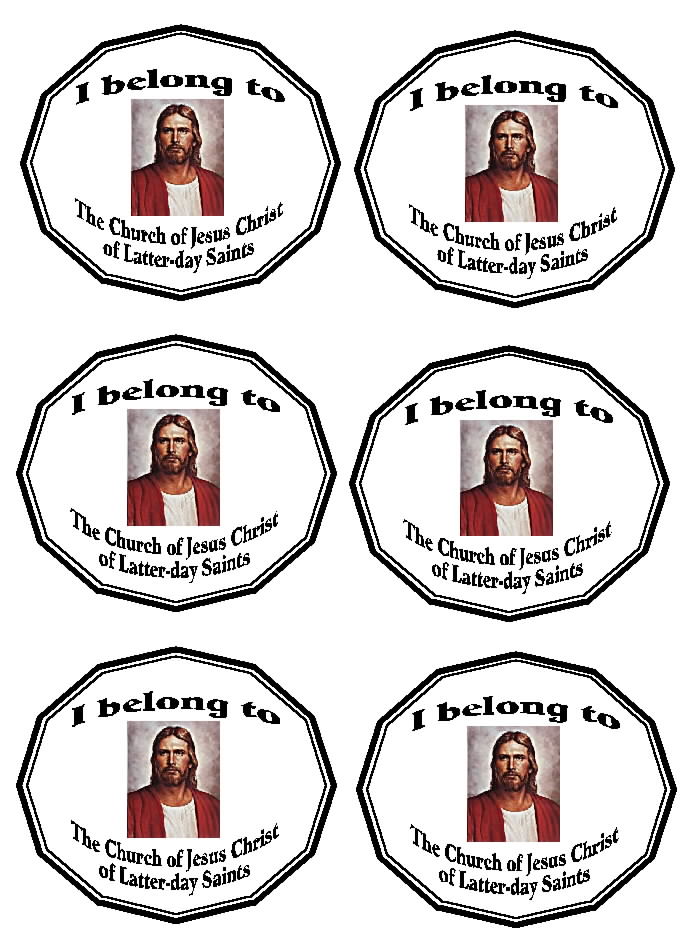
This week's FHE lesson ideas are based on Elder Donald L. Hallstrom's talk "Converted to His Gospel Through His Church."  When I was listening and reading this talk over and over for inspiration, I just kept feeling the urge to sing out that beloved primary song, "I Belong to the Church of Jesus Christ of Latter-day Saints!"  While I love and respect all churches that teach people to do good things with their lives and in the world, I echo the words of Elder Hallstrom--there is nothing like the restored Church of Christ, with the attending fulness of the gospel, in all the world!  It is a remarkable thing to be a part of, and we should help our families understand just what the Church is and what it stands for.  Sometimes I think we just assume our kids pick up on these things over time so we don't explicitly teach them...so that's where most of these ideas are coming from.  There are some real *GEMS* about the importance of being converted to the gospel and not just the Church, and I hope you read and ponder those eternal truths.  But the FHE this week is focusing on the Church's role in teaching the gospel. 

So, here we go!

Before you begin...
QUESTIONS TO PONDER:
  • How have I been converted to the gospel of Jesus Christ?  What experiences led me to my testimony?
  • Do my children/family know the name of the Church?  Do they understand what it means?  Do they know how our faith differs from others--what makes it special?

QUOTES FROM THE TALK:
  • I love this succinct definition of the gospel: "The gospel is the glorious plan of God in which we, as His children, are given the opportunity to receive all that the Father has."  It's the Plan of Salvation, made possible through Christ's atonement! 
  • "This is a magnificent Church. Its organization, effectiveness, and sheer goodness are respected by all who sincerely seek to understand it. The Church has programs for children, youth, men, and women. It has beautiful meetinghouses that number more than 18,000. Majestic temples—now totaling 136—dot the earth, with another 30 under construction or announced. A full-time missionary force of over 56,000, comprised of the young and less so, are serving in 150 countries. The Church’s worldwide humanitarian work is a marvelous display of the generosity of our members. Our welfare system cares for our members and promotes self-reliance in a manner unduplicated anywhere. In this Church we have selfless lay leaders and a community of Saints who are willing to serve one another in a remarkable way. There is nothing like this Church in all the world."
  • "Some have come to think of activity in the Church as the ultimate goal. Therein lies a danger. It is possible to be active in the Church and less active in the gospel. Let me stress: activity in the Church is a highly desirable goal; however, it is insufficient. Activity in the Church is an outward indication of our spiritual desire. If we attend our meetings, hold and fulfill Church responsibilities, and serve others, it is publicly observed. By contrast, the things of the gospel are usually less visible and more difficult to measure, but they are of greater eternal importance. For example, how much faith do we really have? How repentant are we? How meaningful are the ordinances in our lives? How focused are we on our covenants?  I repeat: we need the gospel and the Church. In fact, the purpose of the Church is to help us live the gospel."
SONGS:
  • "I Belong to the Church of Jesus Christ of Latter-day Saints!"
  • "When I Go to Church"
  • "Saturday is a Special Day"
  • "How Will They Know" (unless we teach them so)
OBJECT LESSONS:
  • Apostacy and the Need for a Restoration--have a few blocks labeled with fundamental things in Christ's original church--such as apostles and prophets, baptism, the law/scriptures, priesthood authority, etc.--and build a building.  Talk about how the Apostacy caused division in the Church as you dismantle the building and give some blocks to some kids, some to others.  Explain that no single church had all the same parts as Christ's original church. Then rebuild the building together as you talk about Joseph Smith's revelations and the Restoration.
  • Every Calling is Important to Building the Kingdom: Take the spring out of a pen.  Hold the pen up and ask children what it is, what it's used for, and what they think the most important part of it is.  Then have one child try to write with it--something isn't right!  It can't write!  Insert the spring back into the pen, and let a few children confirm that it is now working properly. Even something as simple as a ballpoint pen needs all its parts to work properly. Some parts may seem more important, like the ink, while others may seem less important, like the spring, but they are ALL needed for it to do what it is supposed to. In our church/class, each of our member's best efforts and talents are needed, too. Everyone has a job to do, whether it's conducting the meeting, teaching a lesson, singing, or simply sharing testimony by participating in class discussions. Some jobs may seem more important than others, but without everyone, the Church just wouldn't function. The apostle Paul said: "But now are they many members, yet but one body. And the eye cannot say unto the hand, I have no need of thee: nor again the head to the feet, I have no need of you. Nay, much more those members of the body, which seem to be more feeble, are necessary." (1 Corinthians 12:20-22).
  • Reverence at Church: parents place a piece of string on the front of their clothing. It should be obviously noticeable.( a color that stands out) Then they begin to talk/sing about what reverence is. After a couple of minutes they ask if anyone noticed the string and if it was distracting. Begin by having a brief discussion on reverence. Help your children understand that if something as little as a thread can distract us, how much more distracting is talking, tapping our foot, or any other form of inappropriate behavior or appearance? Our lack of reverence can distract ourselves and others from feeling the Spirit.
  • Appropriate Sabbath Activities (living the gospel in and after Church): I loved this one.  :)  You can use real ice cream and toppings or just draw/find pictures/talk about it.  You're going to make a big ice cream sundae to share--get out the ice cream, put it in a bowl, and pull out your toppings--pepperoni, Goldfish cracker, BBQ sauce, or other things your kiddos like but that don't really go with ice cream.  Show them the toppings--they will probably gross out.  Ask, "What, you don't like these things?" They'll likely say, "Yes, but not on ice cream sundaes!"  This leads into a discussion of how there are lots of good things that we do during the week that just don't go with Sundays.  Discuss what you as a family believe are positive ways to "remember the Sabbath day, to keep it holy."     
  • Put some cut celery or daisies in a glass vase filled with colored water (might want to make it black or brown, or it will be really pretty and the kids will LIKE it, which sort of defeats the point) a few days before FHE.  Show it to the family and ask what happened to the beautiful, clean flower or veggie?  Just as it absorbed the color from the water, we absorb what we are surrounded by day in and day out.  We need to surround ourselves with clean, happy things--like the things we learn at Church, or living the gospel principles in our home--if we want to remain "unspotted from the world."
GAMES & LEARNING ACTIVITIES:
  • Finger play--"This is the Church, this is the steeple, open up the doors and see all the people.  Close the doors and hear them pray.  Open up the doors, and they all walk away."
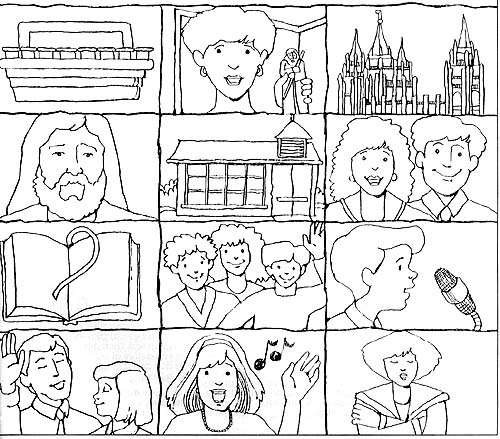
  • Show a picture of Christ and read about the Church's name (D&C 115:4).  Then show pictures (one at a time) of things that set our Church apart from others.  After briefly talking about each one, sing a Primary song related to it.  End with the song "I Belong to the Church of Jesus Christ of Latter-day Saints."  Some ideas:
    • Living Prophet--Follow the Prophet
    • Temple Work--"I Love to See the Temple"
    • The Scriptures, especially the Book of Mormon--"The Golden Plates," "Book of Mormon Stories," "Scripture Power," or the 8th Article of Faith
    • The Priesthood & its ordinances--especially Baptism and any Primary songs related to it
    • Genealogy--"Family History, I Am Doing It."
    • The Plan of Salvation--"I Lived in Heaven" or "I Will Follow God's Plan"
    • etc. :)
  • Create a simple puzzle where each large piece has a different family member's name on it.  Hide the pieces around the house and have the children find them and assemble the puzzle.  Talk about how each person belongs to our family.  Where else do we belong?  (To classes, neighborhoods/communities, to the Church).  Show a picture of a baby getting blessed (or, if you have them, pictures of their OWN baby blessings) and talk about how we belong to the Church because of the name and blessing.
  • Priesthood ordinances--show pictures and talk about baby blessings, baptisms & confirmations, father's blessings, blessings for the sick, the passing of the sacrament, a married couple outside of the temple, etc...anything they might be familiar with.  (The VERY affordable Gospel Art Kit has pictures of all of these things.)  Show pictures of Joseph Smith's receiving each of the Priesthoods and talk about how our Church is the only one with the authority to do each of these ordinances.
  • From the nursery manual: "Before (FHE), draw four simple pictures—an eye, a hand, an ear, and a mouth—on separate pieces of paper. Tell the children that there are many things we can do at church. (Post the picture of an eye.) We can read scripture stories. (Post the picture of a hand.) We can play kindly with our friends. (Post the picture of an ear.) We can listen carefully to our teachers. (Post the picture of a mouth.) We can speak softly while we are in church. Have each child come up and point to one of the pictures. As a picture is pointed to, tell the children again what it stands for."
  • Have each child draw a picture of themselves in their Sunday best and, on the back, write or draw something he or she can do to be a good member of the Church.
  • I LOVE this idea--so simple but so cute--learn how to say "I Belong to the Church of Jesus Christ of Latter-day Saints" in a few different languages, or especially from your mission language.  Teach your kids about how the church is a worldwide Church and even though we might meet at different places, speak different languages, etc., we all believe the same thing.
  • Cut out a bunch of footsteps and have them lead to different places around the house and back again (or just play follow the leader, you could do it outside if the weather is lovely).  Talk about whose footsteps we follow (our parents, good friends, the prophet, Jesus Christ).  Talk about how Christ is the head of the Church, and He shows us the way to go through His prophets.  :)
  • For older children/youth, have a few numbers/statistics about the Church (find them in the statistical report HERE) and accompanying words (like number of missionaries, operating temples, stakes, members, etc.) and make your own memory game (can be fancy and make printable ones from HERE but you certainly can just write it on paper, too :).  You can also make your own word searches or other games with Church-related words/topics HERE.  Talk about how you feel when you hear those statistics and how they have changed even in your own lifetime.
  • Also for older children/youth, the theme for 2003 in Primary was I Belong to the Church of Jesus Christ of Latter-day Saints, and they have a cute puzzle with accompanying scriptures to read HERE.  You could have each family member find a different puzzle piece and put it together, reading their accompanying scripture.
  • Possible with all kids but especially with older children: play Playdoh Pictionary with Church- or Sabbath-related words (sacrament, singing time, reverence, talks, scriptures, etc...or Sabbath-appropriate activities such as journal writing, scripture reading, preparing for Church, writing letters, etc...). 
  • The Redheaded Hostess has some AWESOME graphics representing different parts of the Plan of Salvation as a free pdf HERE. I STRONGLY recommend you print it off, cut it out, laminate it, and put it in a baggie--you will get SO MUCH use out of it over the years.  If you're artsy, you could always draw your own, of course.  Someone on Paul's mission made one similar to this and we used it every Sunday in our lessons--we'd time the kids and see how quickly they could put it all in order, and at the end of every lesson we'd ask how whatever principle we were teaching that week fit into the Plan.  If you teach obedience to Church leaders, commandments, and principles in context of the PLAN, they will more easily see the blessings associated with obedience and the gospel becomes so much more than a list of "do"s and "don't"s.  :)  This is a HUGE part of becoming active in the gospel and not just the Church, which is what Elder Hallstrom's talk is all about!

HANDOUTS AND FREEBIES:
  • Melonheadz Coloring pages (click the description for the link): Keeping the Sabbath Day Holy; Follow the Prophet; Baptism; Confirmation
  • From the Nursery Manual, a coloring page: click HERE.  There's also another one of a Church building HERE.  There's also a bunch of small pictures related to the Church and Sunday worship HERE (it was meant to be cards in a game, but I kinda like it as a coloring page, too).
  • There are some cute, simple badges to print out HERE. Just put on cardstock and turn into a sticker, or use tape or a pin backing or string or whatever else you have on hand. :)  There's another badge where kids get to draw themselves and write their own names HERE.
  • There's a cute, simple paper Church building puzzle made out of different blocks labeled for important Church foundations HERE.
  • There's a little printable booklet HERE to help your children learn the words to the song "I Belong to the Church of Jesus Christ of Latter-day Saints"
  • There's a nice infographic about the Church you could turn into scripture bookmarks HERE.
  • I've made a little 8x10 subway art (you can resize it if you wish) with the words of the song "I Belong to the Church of Jesus Christ of Latter-day Saints" that you can download for free:
(Pink download HERE)

(green download HERE)

(Blue download HERE)
(Rainbow download HERE)


CRAFTS & MORE:
  • If you're teaching about the worldwide church, represent this with little "world sticks"--little globes out of playdough or blue/green paints on styrofoam with a popsicle stick shoved inside.  You could even put a little monopoly house on it.
  • Make one of the handouts/freebies with your kids AS your craft and frame/display it if possible.
  • Again, build church meetinghouses out of blocks, sugar cubes, etc. 
  • Make a FELT memory game with stylized pictures representing different important aspects of the Church/Sabbath day worship/living the gospel.  You could use these for a quiet game not only in FHE but anytime, and they will last a LONG time compared to paper.  :)
TREATS:
  • Sugar cookies in the shape of a house/church.
  • Put chocolate frosting on top of graham crackers and make "missionary nametags"
  • Ice cream SUNDAES--as you eat, discuss what your favorite part of Sundays are, what is/is not appropriate to do on Sundays, and why we go to church every Sunday (see coordinating object lesson above).
  • Bread and water--and talk about the Sacrament, what each of these symbols mean as we partake of them each week at Church.

What other ideas can you come up with?

I know that membership in Christ's true and living Church is absolutely essential to our spiritual progression.  God's house is a house of order.  I'm grateful for the truths that come from the scriptures and prophets.  I'm grateful for the priesthood authority that makes saving ordinances possible.  And I'm thankful that the gospel can be a part of every moment of our lives--indeed, it MUST be if we are to be saved.  I'm happy to sing out, "I Belong to the Church of Jesus Christ of Latter-day Saints!"